The Structure of a Neuron
The cell body of the neuron holds the nuleus and all of the cytoplasmic organelles of a typical cell. Therefore, if the cell body, or soma, is destroyed, the neuron dies. The axon cone is the part of the neuron that is the most sensitive to any changes in the electrical charge of the neuron membrane. The very first part of the neuron that shows the presence of a nerve impulse is called the Action Potential. The axon is an electrically excitable cytoplasmic strand that conducts the action potential as a multiplying depolarization. Axonal arborization is the branching of the axon for communicating with other neurons through synaptic contacts.
Nervous systems have structural cells called glial cells which support the neurons structurally and metabolically. Glial cells also control the nervous systems chemical environment. Axons are usually covered with a specific type of glial cell, called Schwann cells, which give an insulating nerve sheet to stop the axons from having direct contact with each other, which can short circuit electrical impulses. Schwann cells can be in both vertebrate and invertebrate neurons. The vertebrate neurons wrap repeatedly around the axon. The membrane windings tighten down on the axon to create a myelin sheath. This myelin sheath on the vertabric neurons isn't continuous; it is interrupted at intervals with gaps called the nodes of ranvier. However, invertebrate neurons wrap loosely around the axon, and they do make a continuous sheath. 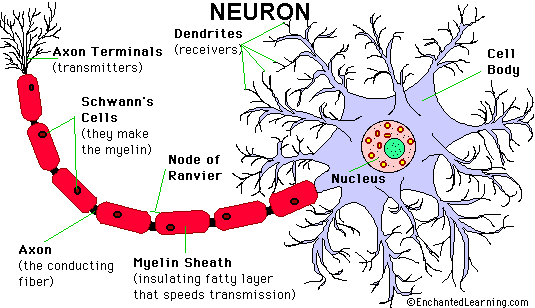
Human Nervous System
The human nervous system has two different parts. First, there's the central nervous system, which is also divided into two different parts: the brain, and the spinal cord. The average adult brain weighs about 3 pounds. The brain contains around one hundred billion neurons, and trillions of support cells called glia. The spinal cord is about 43 centimeters long in adult women, and 45 centimeters long in adult men. It usually weighs around 35-40 grams. The backbone is around 70 centimeters long.
The second part to the human nervous system is the peripheral nervous system. Just like the central nervous system, the peripheral nervous system is also divided into two parts: the somatic nervous system and the autonomic nervous system. The somatic nerve system has peripheral nerve fibers that give sensory information to the central nervous system, and it also has motor fibers that project to skeletal muscle. 
The diagram above shows the somatic motor system. The cell body is located in either the brain or the spinal cord and projects directly to a skeletal muscle. The autonomic nervous system controls smooth muscle of the internal organs and glands. The autonomic nervous system has three parts: sympathetic, parasympathetic, and enteric nervous systems.

Above is the general organization of the autonomic system. The preganglionic neuron is either in the brain or the spinal cord and projects to an autonomic ganglion. Then, a postganglionic neuron projects to the target organ. A difference between the somatic and autonomic systems is: the somatic nervous system has just one neuron between the central nervous system and the target organ. The autonomic system uses two neurons. The enteric nervous system is a meshwork of nerve fibers that innervate the viscera (gastrointestinal tract, pancreas, gall bladder.)
SUBTLE DIFFERENCES
1) The central nervous system has collections of neurons that are called nuclei. The peripheral nervous system has collections of neurons called ganglia.
2) The central nervous system has collections of axons called tracts. The peripheral nervous system has collections of axons called nerves.
The Human Brain
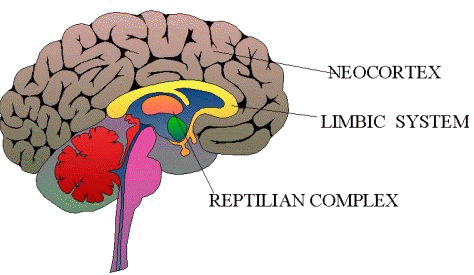
The human brain has three different parts: reptilian, limbic, and neocortex. Those three parts don't operate alone, though. The actually have various interconnections through which they influence one another.
The reptilian brain is the oldest out of the three, and it controls the body's vital functions (heart rate, breathing, body temperature, and balance). It includes the main structures found in a reptiles brain: the brainstem and the cerebellum. The reptilian brain is reliable, but can sometimes be kind of rigid and compulsive.
The limbic brain came in the first mammals. It records memories of behaviours that made agreeable and disagreeable experiences, and it is responsible for human emotions. Its main structures are: hippocampus, amygdalam and hypothalamus. This brain is responsible for the judgments we make, which are usually unconscious, and it has a very strong influence on our behaviour.
The neocortex was first shown in primates, and it ended in the human brain with two large cerebral hemispheres that play a big role. These hemispheres hold responsibility for the development of human language, abstract thought, imagination, and consciousness. The neocortex is flexible and has almost infinite learning abilities, and it as enabled human cultures to develop.
|
|
How Neurons Transmit Impulses
The brain has millions of nerve cells, and the signals sent from one part of the brain to another can be described as students in a classroom passing a note from the front to the back. Nerve cells communicate at a crossroads called a synapse, where signals move from one neuron to another. There is a small space between two cells called a synaptic cleft, where all of the "magic" happens. The cell that sends the message is filled with round sacs called vesicles that hold neurotransmitter molecules. The neurotransmitters used along the reward pathway is dopamine. The cell that receives the message is coated with dopamine receptors. Then, an electrical impulse triggers the vesicles in the sending cells to dump their contents into the synaptic cleft. After, dopamine molecules are released into the synaptic cleft, where they attach to the dopamine receptors on the receiving cell just like a lock and key. When a dopamine is in its place, the receptor into motion a few different events, resulting in the formation of a second messenger molecule. When the dopamine is done its job, it's released from the receptor and gets to travel back to the sending cell through reuptake transporters; then, it's either packaged for reuse, or it's broken down. Once made, the second messenger starts a nerve impulse that travels down the axon of the neuron. When the impulse reaches the neuron, vesicles with neurotransmitters are stimulated to dump their contents. The receiving cell has now become a sending cell. Finally, the whole process starts all over again.
This isn't always the case, though. The impulses aren't always transmitted. This can happen when not enough neurotransmitters attach to receptors. If that happens, the neuron won't send an impulse. Also, some neurotransmitters are just inhibitory, which means that they just stop a nerve impulse from being carried on.
FUN FACT!!
1 neuron can synapse with as many as 1,000 other neurons!
Flatworm (Planaria) Nervous System
Flatworms have a collection of separate but "connected" neurons called a nerve net. This nerve net is connected by long nerve cords. The nerves are connected to a cerebra ganglia, which can be found in the head. The nervous system is sometimes described as "ladder like", because of the nerves connecting the nerve cords. Flatworms have auricles that project from the side of the head, which contain chemoreceptors that are used to find food. They also have eyespots called ocelli, which connect to the cerebral ganglia. They are extremely sensitive to light, which causes the flatworm to stay in darker places.
The earthworm's nervous system is "segmented", just like the rest of their body. The brain is found above the pharynx, and is connected to the first ventral ganglion. Each segmented ganglion gets sensory information from only a local region of its body, and controls muscle only in this region. Earthworms have touch, light, vibration, and chemical receptors all along their entire body surface.
DID YOU KNOW?
1) If the earthworm's brain is removed, it will move continuously!
2) If the earthworm's first ventral ganglion is removed, it will sop eating and it will no longer dig!
Something To Think About:
Our brain has evolved from three different things that aren't human: reptiles, the first mammals, and primates. Primates have the neocortex, which is the part of the brain that holds as much knowledge as we wish for it to hold. Is this why monkeys and other primates are often compared so much to humans, and can learn to do human tasks that other animals cannot do? I think the answer is: yes!
|