Sexual & Asexual Reproduction
There are two types of reproduction: sexual reproduction, and asexual reproduction. Asexual reproduction means reproducing without any interaction of two genders, while sexual reproduction involves the fusion of two cells called gametes, one being from a male source and the other from a female source. Before a cell divides, its nucleus divides. Each chromosome is copied, and each nucleus gets the same genetic material (genes made of the same DNA). As each cell divides in two, the resulting "daughter" cells are exact copies of each other. Asexual reproduction in plants has many examples. One is the spider plant, which makes plantlets on stolons branching from buds in the parent plant. These are usually identical and will grow to look alike, if they are raised in the same environment. Identical twins are also produced by a form of asexual reproduction, when the ball of cells making up the embryo breaks into two, and each implants in the uterus and grows independently.
A summary of the differences: -Asexual Reproduction (AR) needs only one parent, male or female, while Sexual
Reproduction (SR) needs two parents,one male and the other female.
-With AR, the offspring is genetically identical to the parent & other offspring, while with SR,
the offspring is genetically different.
-AR: normal cell division following nuclear. SR: special cell division following nuclear
division producing sex cells
-The life cycle of AR is useful when the conditions are ideal for growth, and the life cycle of
SR may be synchronized with the end of growing season.
Advantages of the two are: -AR is quick and good for bulking up numbers, and SR produces variation and is the basis
for evolution.
Disadvantages of the two are: -With AR, any disease may affect all the offspring, and SR is slower and needs a special
process to bring together gametes and protect the zygote, embryo, etc during its
development.
Internal & External Fertilization
External fertilization happens mostly in wet environments, and requires both gametes from the male and female to be released into their surroundings. Two examples of creatures that reproduce this way are fish and amphibians. Flagellated sperm needs fluid to swim, because the eggs don't have a protective shell to be penetrated by sperm and would dry out. One good thing about external fertilization is that its end result is quite a large number of offspring being made. However, a bad thing is that the environmental hazards, such as predators, lowers the chances of adulthood survival, and lots of sperm doesn't reach an egg for fertilization.
Internal fertilization happens in humans and mostly land animals. The sperm cells are provided with fluid in order to swim through in the female reproductive trait. When the fertilized egg has been released by the female or kept inside the body, it stays until its completed its embryonic development. Internal fertilization can't happen without close physiological and behavioral synchronization of both partners, involving hormonal control. Animals that use internal fertilization are very protective of the developing egg. The protection is taken to another level with mammals (except egg laying mammals like birds) by allowing embryo development in the mother, which ups the chances of survival since the mother supplies all the embryo needs. Most mothers also continue taking care of their children for years after they were born.
Fertilization In An Earthworm
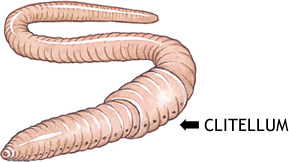
The fertilization process starts in the second part of the reproductive process for earthworms. There is a special, slimy substance that's formed by the clitellum (or sex band). The slime then forms a tube around the earthworm. Then, the worm crawls back into its tunnel and the slime tube slips forward off its body. As this happens, the tube passes over the male and female openings, and the eggs (from the parent) and the sperm (from the mate) are released from the body. Fertilization happens outside of the body, but it takes place inside the slime tube. Once the slime tube is in the soil, it dries and shrinks, making a protective cocoon over the eggs. Earthworms are hermaphrodites (meaning they have both the male reproductive organ and the female reproductive organ), so they have the ability to produce both sperm and eggs. However, they need another earthworm to reproduce, because then cannot reproduce on their own.
Amniotic Eggs
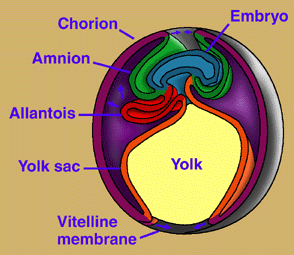
Amniotic eggs are formed by land creatures that lay eggs. Amniotic eggs have a hard shell with a membrane inside. The Amnion is a fluid filled sac that surrounds and cushions the developing embryo. The Chorion regulates the oxygen transportation from the egg's surface to the embryo, while carbon dioxide from respiration is sent the other way. Then, there's a yolk sac, which contains yolk as a food supply for the embryo.
The Production Of Semen in Mammals
For mammals, when producing semen, the liquid mixture is propelled forward through the ejaculatory ducts towards the urethra, first passing through the prostate gland, where milky prostatic fluid is added, creating semen. The prostatic fluid makes it easier for the sperm to swim, which makes it easier to get to the egg. Finally, about a teaspoon of semen is ejaculated through the far end of the urethra, which is at the end of the penis. Once the sperm leaves the males body, it has between twelve and forty-eight hours to find and fertilize an egg if it's available. Out of 300 million sperm ejaculated, only around 200 or so will survive to reach the egg. Then, only one sperm will succeed in fertilizing it.
The Human Female Reproductive Cycle
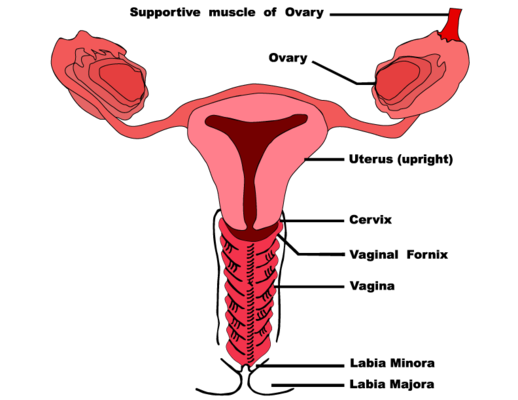
"The main function of the female reproductive system is to produce ova. In addition, the female reproductive system prepares the female's body to nourish a developing embryo" That quote is from page 1011 in the Prentice Hall Miller-Levine Biology text book. The female reproductive system is opposite to the male reproductive system: instead of making millions of sperm each day, the ovaries usually make only one mature egg per month.
Females go through their menstrual cycle, or period, once a month. The cycle takes around 28 days, give or take. It's regulated by hormones made by the hypothalamus, pituitary gland, and ovaries. Menstruation begins at puberty and ends when a female goes through menopause. During this cycle, an egg develops and is released from an ovary. Plus, the uterus is expecting a fertilized egg. If the egg isn't fertilized, it is discharged, and so is the lining of the uterus. There are four phases to the cycle: the follicular phase, ovulation, luteal phase, and menstruation.
Ovulation is the shortest phase in the cycle. It happens midway through the cycle and lasts three to four days long. During this phase, the hypothalamus sends a big amount of releasing hormone to the pituitary gland. This makes the pituitary gland produce FSH and LH. The release of these hormones makes the follicle rupture, making a mature egg get released into one of the Fallopian tubes.
The luteal phase starts after the egg is released. While the egg moves through the Fallopian tube, the cells of the ruptured follicle go through a change. The follicle turns yellow and is now known as the corpus luteum. The corpus luteum continues to release estrogen, and is also starting to release progesterone. In the first two weeks of the cycle, rising estrogen levels stimulate cell growth and tissue development in the lining of the uterus. Progesterone then stimulates the growth and development of the blood supply and surrounding tissue. In the first two days of this phase, right after ovulation, an egg has the greatest chances of being fertilized. This happens usually around day 10 to day 14 after the finishing of the last cycle. If an egg is fertilized by the sperm, the egg will start to divide from mitosis. After a couple of divisions, a ball of cells forms and impants itself in the lining of the uterus. The embryo then keeps growing by constant mitotic divisions. In a few days after implantation, the uterus and the growing embryo release hormones that keep the corpus luteum functioning for several weeks. This lets the lining of the uterus nourish and protect the developing embryo.
Menstruation is what happens if fertilization doesn't happen. Within two or three days of ovulation, the egg passes through the uterus without implanting. The corpus luteum then starts to disintegrate. As the old follicle breaks down, it releases less estrogen and less progesterone. When the level of estrogen is lower than it would be with a fertilized egg, the lining of the uterus starts to detach from the wall. This tissue, as well as blood and the unfertilized egg, are discharged through the vagina. This lsats an average of three days to a week. A new cycle begins the first day of menstruation.
Implantation happens when the cells nestle into the uterine lining & rupture tiny blood vessels. The result is a connective web of blood vessels and membranes that provides nourishment for the developing fetus for the rest of the nine months (or until it is born, if premature). After implantation occurs, the embryonic stage begins:
In the first month of the development, that's when fertilization begins. Implantation begins. In that month, the heredity and gender are formed, as well as a single baby, twins, or more. Then, the estimated time of pregnancy can be discovered. The body starts developing. After thirty days, the developing baby has a brain, eyes, ears, mouth, kidneys, liver, an umbilical cord, and a heart that pumps its own blood.
In the second month, the baby continues growing. It forms hands and feet, developing its fingerprints by the seventh week, and its eyes and ears are taking more shape. The baby also starts moving around this time, although it is not enough to be felt. The baby's brain begins to function, and the baby is responsive to touch. This is when the embryo turns into a fetus.
In the third month, it is now obvious whether the baby is a boy or a girl. The baby now measure almost 90 mm, and its face is narrower with its eyes closed. The baby is far more sensitive to touch now, and it is more susceptible to pain. At eleven weeks, the baby begins practicing for life outside the womb. This includes beginning to swallow the amniotic fluid and pass it back in its urine. It also produces facial expressions such as smiling, and it makes movements as if it is breathing. The baby also sometimes sucks its thumb.
In the fourth and fifth months, the baby reaches a little over one third the height it will be at birth, and the uterus begins to grow. The baby can now start responding to sound. The baby is also sensitive to light.
In the fifth month and up, the baby is growing hair, eyelashes, and fingernails. In this developmental stage, the baby starts gaining fat beneath the skin, as well as gaining weight. The baby is now more noticeable while it's awake or sleeping. Studies have shown that when the mother is tired or under stress, the baby is, too. When the mother is laying down at night, the baby's movements are the most noticeable. The baby kicks, hiccups, and practices its breathing movements. In the later parts of the pregnancy, the baby shows waking, calm sleeping, and eye movements associated with dreaming in adults. The baby also moves around in the womb to find positions that are comfortable for it, and the baby does its final preparations for life outside of the womb.
There are several things that can go wrong in a pregnancy, affecting the outcome of the child. Folic Acid is one of them. It plays a major part in development of DNA, cell growth and development, and tissue formation. If the mother doesn't get enough folic acid, the baby could develope an incomplete development of the brain and the spinal cord. This happens within the first month of pregnancy, often times before a woman even knows she is carrying a child. Another thing that affects pregnancy is drinking. If a mother drinks during her pregnancy, the alcohol flows through the placenta and to the fetus, exposing the child firsthand to the alcohol. A child with fetal alcohol syndrome, caused by drinking, has developmental problems, low muscle tone, problems with social skills, thinking and speech problems, bad coordination, and even sometimes issues with their face.
For the prevention of pregnancy, women often times go on birth control. Birth control can be found in a couple of different forms: a patch, a shot, and most commonly, a pill. Birth control stops ovulation. This means there is no egg, so it cannot get fertilized by sperm. Most pills have fake forms of estrogen and progestin. The synthetic estrogen stops the pituitary gland from making follicle stimulating hormone (FSH) and luteinizing hormone (LH), which stops ovulation. The synthetic progestin stops the pituitary gland from producing LH, which then stops the release of an egg. It also makes the uterine lining unable to hold a fertilized egg, and it partially limits the sperm's ability to fertilize an egg. If a person is on the birth control pill, they need to take it at the same time every day to get the best results, because it creates a more stable level of hormones in the body.
In-vitro Fertilization
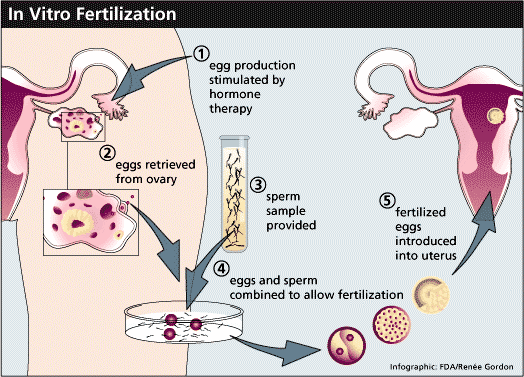
In-vitro fertilization is one of the ways a woman can become pregnant. With this, an egg is fertilized by sperm outside of the body, in a medical lab. Then, the egg is implanted into the woman's uterus. This is usually an option for single women who want children of their own, or women who have tried and failed to conceive with their partner. In this process, the woman's ovulatory process is closely monitored, removing her eggs from her body. Then, sperm fertilizes the egg in a fluid medium in a laboratory. Then, the egg is implanted in the uterus.
Before In-vitro, a woman needs to undergo hormone therapy about two weeks before the procedure. Fertility drugs are given to the woman, and blood tests and ultrasounds are also given to see the best time to retrieve the eggs. The eggs need to be taken just before ovulation. Then, the eggs are retrieved and fertilized. About eighteen hours after that, it's usually easy to determine whether or not the eggs were fertilized. If they were, then they get implanted into the uterus. For the next two weeks after, the woman is give more hormones to help with the implantation. If the process is successful, the eggs attach to the uterine wall. Then, a pregnancy test will be positive!